Embedding Ubuntu and Indigenous Business Insights in Zambia: Advancing a Neuro-Responsible Governance Framework for the Global South


Downloads
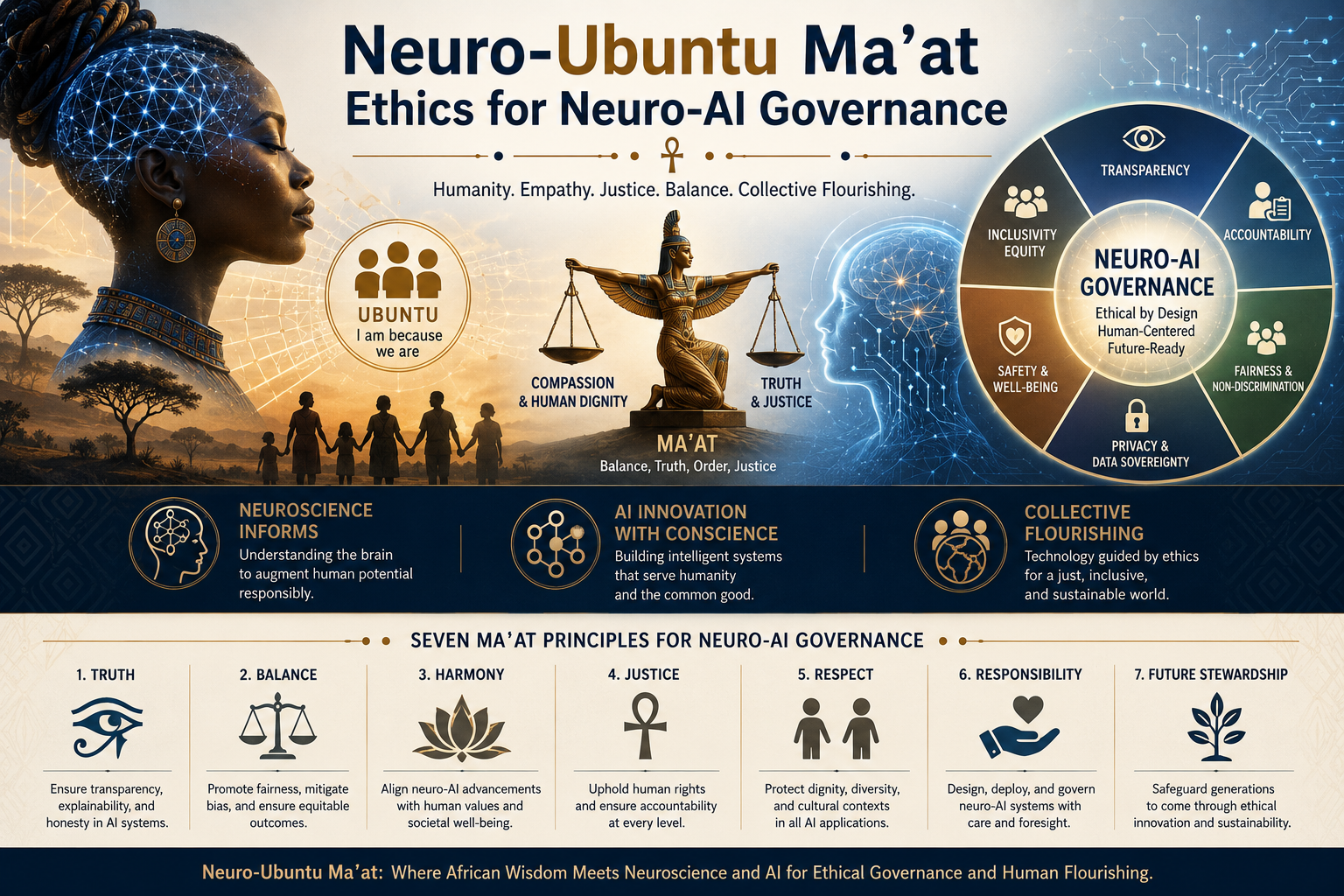
The accelerating convergence of neuroscience and business management presents ethical, cultural, and governance challenges for the Global South. This paper systematically reviews interdisciplinary literature to examine how indigenous Zambian business practices and Ubuntu philosophy can inform neuro-responsible governance frameworks. Drawing on neuroethics, technology governance, and African philosophical traditions, the review identifies relational ethics, communal accountability, and moral stewardship as key principles for protecting cognitive privacy, mental autonomy, and neuro-rights. It highlights persistent epistemic asymmetries in global neurotechnology governance, where African perspectives remain underrepresented, and demonstrates how culturally grounded values can temper individualistic policy assumptions. The synthesis advances a context-sensitive framework integrating Ubuntu with modern neuroethical standards, promoting cognitive dignity, ethical reciprocity, and shared responsibility in corporate and policy settings. By situating Zambia as a normative reference, the study provides guidance for inclusive, pluralistic, and ethically robust neurotechnology governance across businesses within the Global South.
Ajitoni, B. D. (2024). Ubuntu and the philosophy of community in African thought: An exploration of collective identity and social harmony. https://acjol.org/index.php/jassd/article/view/5672
Alvesson, M., & Sandberg, J. (2011). Generating research questions through problematization. Academy of Management Review, 36(2), 247–271. https://doi.org/10.5465/amr.2009.0188
Alvesson, M., & Sköldberg, K. (2018). Reflexive methodology: New vistas for qualitative research (3rd ed.). SAGE Publications. https://doi.org/10.4135/9781036211523
Andanda, P., & Düwell, M. (2024). Individualistic versus relational ethics: A contestable concept for (African) philosophy. Ethical Theory and Moral Practice. https://doi.org/10.1007/s10677-024-10445-0
Asghar, N. M. S., & Naz, N. H. (2025). Neurorights: Minding the integrity of mind. Critical Review of Social Sciences Studies, 3(1), 1816–1824. https://doi.org/10.59075/sjehqw96
Bhatnagar, K., Cayla, J., Dion, D., & Fuschillo, G. (2024). Consumer sovereignty and the ethics of recognition. Journal of Business Ethics, 192(1), 1–19.
Boell, S. K., & Cecez-Kecmanovic, D. (2014). A hermeneutic approach for conducting literature reviews and literature searches. Communications of the Association for Information Systems, 34, Article 12. https://doi.org/10.17705/1CAIS.03412
Borbón, D. (2025). Free will skepticism, neurorights, and coercive moral neuroenhancements: An approach from neuroabolitionism. In Ethics of science and technology assessment/Wissenschaftsethik und Technikfolgenbeurteilung (pp. 13–36). https://doi.org/10.1007/978-3-031-96055-0_2
Botes, M., Labuschaigne, M., Casteleyn, C., Inkster, B., & Sheppard, M. (2025). Decoding the brain, respecting the person: A neuroethical inquiry into consent and cognitive liberty in South Africa. Neuroethics, 18(3). https://doi.org/10.1007/s12152-025-09615-3
Chigangaidze, R. (2025, August 19). An exposition of the relevance of Ubuntu philosophy in social work: A humanistic social work perspective. https://eprints.staffs.ac.uk/9183/
De Sousa Santos, B. (2018). The end of the cognitive empire. Duke University Press. https://doi.org/10.1215/9781478002000
Delina, G., Badada, B., Krishnaraj, R., Thiruthuvanathan, M. M., & Kumar, R. M. (2024). A narrative synthesis on the role of affective computing in fostering workplace well-being using a deep learning model. In Lecture Notes in Networks and Systems (pp. 431–445). https://doi.org/10.1007/978-981-97-6992-6_32
Dhutraj, A., Ansari, N., & Gupta, N. (2026). Human augmentation and the future of work: Ethical considerations for HR leaders.
Doshi, K. (2024, January 1). Transcending the notions of human rights in the age of neuroscience. http://14.139.185.167:8080/jspui/handle/123456789/1377
Ewuoso, C., & Hall, S. (2019). Core aspects of Ubuntu: A systematic review. South African Journal of Bioethics and Law, 12(2), 93. https://doi.org/10.7196/sajbl.2019.v12i2.679
Farisco, M. (2024). Neuroethics and cultural diversity. John Wiley & Sons.
Flyvbjerg, B. (2006). Five misunderstandings about case-study research. Qualitative Inquiry, 12(2), 219–245. https://doi.org/10.1177/1077800405284363
Gilbert, F., & Russo, I. (2024). Mind-reading in AI and neurotechnology: Evaluating claims, hype, and ethical implications for neurorights. AI and Ethics, 4(3), 855–872. https://doi.org/10.1007/s43681-024-00514-6
Greenhalgh, T., & Peacock, R. (2005). Effectiveness and efficiency of search methods in systematic reviews of complex evidence: Audit of primary sources. BMJ, 331(7524), 1064–1065. https://doi.org/10.1136/bmj.38636.593461.68
Greenhalgh, T., Wong, G., Westhorp, G., & Pawson, R. (2011). Protocol—Realist and meta-narrative evidence synthesis: Evolving standards (RAMESES). BMC Medical Research Methodology, 11(1). https://doi.org/10.1186/1471-2288-11-115
Hertz, N. (2025). The human right to freedom of thought—Operationalising a disputed right in the context of neurotechnologies. Human Rights Law Review, 25(3). https://doi.org/10.1093/hrlr/ngaf015
Igboin, B. O. (2025). Ubuntu: African personhood and the reconstitution of global community. In Fraternity as an overlooked element in global politics (pp. 237–251). Routledge.
Irakoze, A. D. (2025). Ubuntu as a relational framework: Addressing social injustices in mineral resource governance to advance sustainable development in Burundi. University of Bayreuth. https://doi.org/10.15495/epub_ubt_00008636
Jennings, T. L. (2025a). Sharing the same lens. In IGI Global eBooks (pp. 231–268). https://doi.org/10.4018/979-8-3693-8653-8.ch010
Note: Duplicate entry 2025b removed per APA rules.
Johnson, W. G. (2025). It’s (not) just semantics: “Neurotechnology” as a novel space of transnational law. Law & Social Inquiry, 1–28. https://doi.org/10.1017/lsi.2025.29
Johnson, W. G., Tournas, L. M., & Nadler, R. M. (2024). Implementing neurorights: Legal and regulatory considerations. Neuroethics, 18(1). https://doi.org/10.1007/s12152-024-09576-z
McCullum, T., & Mancera, L. C. C. (2025). Neurotechnology combined with artificial intelligence and neurorights: A legal discussion. Revista La Propiedad Inmaterial, 39, 145–183. https://doi.org/10.18601/16571959.n39.06
Mishra, P. (2024). Neuroscientific paradigms and their implications for jurisprudential practice: A comparative analysis. Athens Journal of Law, 10(3), 317–330. https://doi.org/10.30958/ajl.10-3-4
Mogaji, E. (2025). Reimagining transformative services in unregulated markets: Conceptualising inclusive service provision in informal and developing country contexts. Journal of Services Marketing, 1–13. https://doi.org/10.1108/JSM-01-2025-0008
Muravieva, L. (2025). Regulating neurotechnologies and AI-driven neural implants in the European Union: Legal and ethical challenges. LUP Student Papers. https://lup.lub.lu.se/student-papers/search/publication/9194495
Mwinsa, G. L., Kasoka, K., Ferguson, B., & Griffiths, F. (2025). International bioethics, Ubuntu, and HIV testing in Sub-Saharan Africa: An evaluation of Zambia’s HIV testing policy. Journal of Medical Ethics. https://doi.org/10.1136/jme-2024-110043
Narvaez, D. (2024). Returning to evolved nestedness, wellbeing, and mature human nature: An ecological imperative. Review of General Psychology, 28(2), 83–105. https://doi.org/10.1177/10892680231224035
Ndasauka, Y. (2024). Harmonising technology and humanity through Ubuntu. In African mind, culture, and technology: Philosophical perspectives (pp. 129–150). Springer Nature Switzerland.
Ndlovu-Gatsheni, S. J. (2018). Epistemic freedom in Africa: Deprovincialization and decolonization. Routledge.
Neethirajan, S. (2024). From predictive analytics to emotional recognition: The evolving landscape of cognitive computing in animal welfare. International Journal of Cognitive Computing in Engineering, 5, 123–131. https://doi.org/10.1016/j.ijcce.2024.02.003
Nnodim, P., & Okigbo, A. (2024). Ubuntu: Opportunities and challenges for Africa and the world. In Ubuntu: A comparative study of an African concept of justice (p. 229). Leuven University Press.
Nuechterlein, A., Boyle, Q., & Illes, J. (2024). Reimagining expertise and neutrality towards epistemic justice in research, clinical translation, and policy. In Routledge eBooks (pp. 111–127). https://doi.org/10.4324/9781003374480-9
Okogbe, O. (2025, February 12). Respect as a pillar of African Ubuntu philosophy. https://acjol.org/index.php/NJP/article/view/6322
Onyango Ouma, S. (2025). Human minimum and the spirit of Ubuntu. In The right to a human minimum: H. Odera Oruka on bridging the gap between the rich and the poor (pp. 93–133). Springer Nature Switzerland.
Passos Maia, A., Maia, R., & Amaral, L. (2025). The commodification of free will: Neurotechnology and ethical challenges in the workplace. In Neurolaw: Legal impacts of neurotechnology (pp. 263–277). Livraria do Advogado.
Paz, A. W. (2021). Is mental privacy a component of personal identity? Frontiers in Human Neuroscience, 15. https://doi.org/10.3389/fnhum.2021.773441
Pravotorova, O., Shumilo, O., Talanchuk, I., Lien, T., Zlenko, N., & Podorozhnyi, V. (2025). Theoretical and methodological aspects of the genesis of legal misconduct in the neuroethical dimension. Brain Broad Research in Artificial Intelligence and Neuroscience, 16(2), 120–133. https://doi.org/10.70594/brain/16.2/9
Rieger, J. (2021). Rethinking religion and what really matters. Stellenbosch Theological Journal, 7(2). https://doi.org/10.17570/stj.2021.v7n2.a1
Rinta-Pollari, H. (2024). Navigating the maze: Exploring the intersection of human rights and the quest for neurorights in Europe. DIVA. https://www.diva-portal.org/smash/record.jsf?pid=diva2:1883504
Rudroff, T. (2025). Consent and autonomy in the age of predictive neuroscience. In Neurocultural health and wellbeing (pp. 153–205). https://doi.org/10.1007/978-3-032-11596-6_6
Sipondo, A. (2025). Ubuntu ethical leadership in the African public sector: Conceptual proposals. International Journal of Public Leadership, 21(2), 140–154. https://doi.org/10.1108/IJPL-10-2024-0119
Stahl, B. C. (2025). The ethics of data and its governance: A discourse theoretical approach. Information, 16(6), 497. https://doi.org/10.3390/info16060497
Tantaru, F. (2025, August 5). Neuroethics in digital contract breach: A study of morality and decision-making in platform-based transactions. https://seer.ucp.br/seer/index.php/LexHumana/article/view/3336
Tranfield, D., Denyer, D., & Smart, P. (2003). Towards a methodology for developing evidence-informed management knowledge by means of systematic review. British Journal of Management, 14(3), 207–222. https://doi.org/10.1111/1467-8551.00375
Vasiliu-Feltes, I. (2025). Neurotech frontiers: Ethics, identity, and the evolution of brain–computer interfaces. In Nanomedical brain/cloud interface: Explorations and implications. IOP Publishing.
Weick, K. E. (1995). Sensemaking in organizations. SAGE Publications.
Copyright (c) 2026 Edward Musole (Author)

This work is licensed under a Creative Commons Attribution-NonCommercial-NoDerivatives 4.0 International License.
By submitting your manuscript to IJABS, you agree and confirm that the paper you have submitted is your own original and unpublished work, does not contain any defamatory or other unlawful content(s), and you will accept responsibility for plagiarism. You and your co-authors retain copyright and grant BESRA the right of publication, with the work simultaneously licensed under a Creative Commons Attribution License 4.