Artificial Intelligence in Higher Education: A Thematic Integrative Review of Applications, Users, Ethics, and Institutional Consequences

Downloads
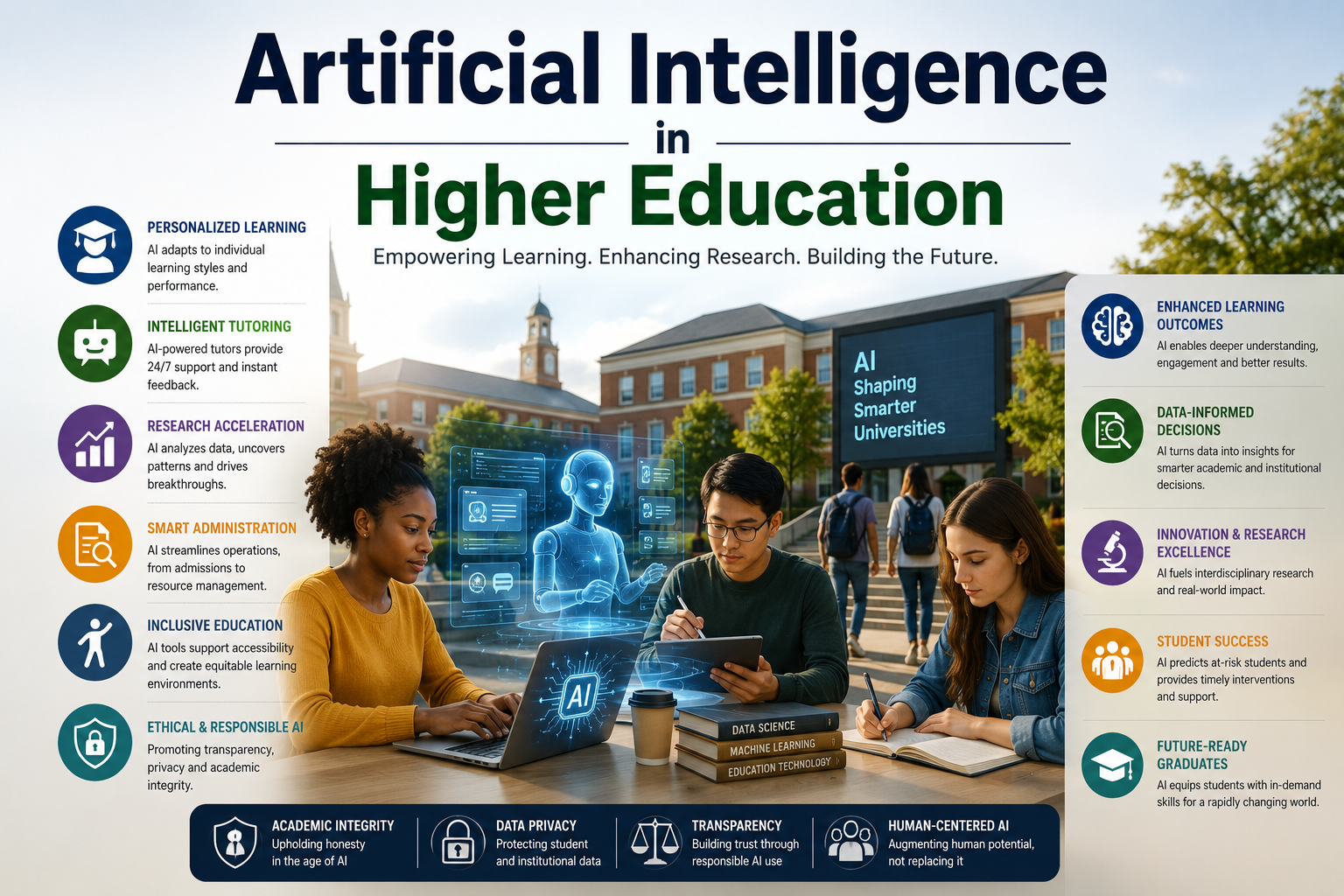
The rapid diffusion of artificial intelligence (AI) across higher education has intensified debates regarding its pedagogical value, ethical implications, and institutional governance. Although a growing body of research documents specific AI-driven applications, less attention has been paid to who uses AI in higher education, for what purposes, under what ethical conditions, and with what institutional consequences. This study adopts a thematic integrative literature review to synthesise peer-reviewed research and policy literature on AI use in higher education published between 2011 and 2025. Guided by six analytical questions, the review examines key actors, dominant AI platforms and applications, purposes of use, ethical practices, existing ethical guidelines, and persistent research gaps across teaching and learning, assessment, research, administration, and student support. The findings reveal uneven and stratified patterns of AI adoption, with students and academic staff emerging as the dominant users, growing reliance on generative AI tools, fragmented ethical governance, and limited institutional readiness. Building on these insights, the study advances a conceptual framework that conceptualises AI use in higher education as a socio-technical process shaped by institutional actors, ethical principles, and governance mechanisms. The review concludes by identifying critical gaps in empirical evidence, ethical implementation, and Global South-focused research, and outlines implications for future scholarship, policy, and institutional practice.
Adigun, O. T., & Ojomo, O. T. (2025). Application of Artificial Intelligence for Inclusive Education. In Enablers, Barriers, and Challenges for Inclusive Curriculum (pp. 147-166). IGI Global Scientific Publishing.
Al-Omoush, K. S., Garrido, R., & Canero, J. (2023). The impact of government use of social media and social media contradictions on trust in government and citizens’ attitudes in times of crisis. Journal of Business Research, 159, 113748.
Bond, M., Marín, V. I., Dolch, C., Bedenlier, S., & Zawacki-Richter, O. (2018). Digital transformation in German higher education: student and teacher perceptions and usage of digital media. International journal of educational technology in higher education, 15(1), 48.
Dhara, S., Chatterjee, S., Chaudhuri, R., Goswami, A., & Ghosh, S. K. (2022). Artificial intelligence in assessment of students' performance. In Artificial Intelligence in Higher Education (pp. 153-167). CRC Press.
Dwivedi, Y. K., et al. (2023). So what if ChatGPT wrote it? Multidisciplinary perspectives on opportunities, challenges and implications of generative conversational AI for research, practice and policy. International Journal of Information Management, 71, 102642. https://doi.org/10.1016/j.ijinfomgt.2023.102642
Floridi, L., et al. (2018). AI4People—An ethical framework for a good AI society: Opportunities, risks, principles, and recommendations. Minds and Machines, 28(4), 689–707. https://doi.org/10.1007/s11023-018-9482-5
Holmes, W., Bialik, M., & Fadel, C. (2019). Artificial intelligence in education: Promises and implications for teaching and learning. Center for Curriculum Redesign.
Jensen, L. X., Buhl, A., Sharma, A., Bearman, M., & others. (2024). Generative AI and higher education: A review of claims from the first months of ChatGPT. Higher Education. Advance online publication. https://doi.org/10.1007/s10734-023-01072-0
Jwair, A. A. B. (2025). Generative artificial intelligence in higher education: Students’ journey through opportunities, challenges, and the horizons of academic transformation. Cogent Education, 12(1), 2589495.
Kasneci, E., et al. (2023). ChatGPT for good? On opportunities and challenges of large language models for education. Learning and Individual Differences, 102, 102247. https://doi.org/10.1016/j.lindif.2023.102247
Lelescu, A., Sava, S., Grosseck, G., & Mălita, L. (2025). Exploring trust in generative AI for higher education institutions: A systematic literature review focused on educators. Humanities and Social Sciences Communications, 12, 1961. https://doi.org/10.1057/s41599-025-01961-5
Luckin, R., & Holmes, W. (2016). Intelligence unleashed: An argument for AI in education. Pearson
Maxwell, D., Oyarzun, B., Kim, S., & Bong, J. Y. (2025). Generative AI in higher education: Demographic differences in student perceived readiness, benefits, and challenges. TechTrends, 69, 1248–1259. https://doi.org/10.1007/s11528-025-00978-4
Marino, D., Aragona, F., & Domenico/Cananzi Marino (Daniel). (2024). Ethics and Artificial Intelligence.
Marín, Y. R., Caro, O. C., Rituay, A. M. C., Llanos, K. A. G., Perez, D. T., Bardales, E. S., ... & Santos, R. C. (2025). Ethical challenges associated with the use of artificial intelligence in university education. Journal of Academic Ethics, 23(4), 2443-2467.
Ng, S.-L., & Ho, C.-C. (2025). Generative AI in education: Mapping the research landscape through bibliometric analysis. Information, 16(8), 657. https://doi.org/10.3390/info16080657
Qian, Y. (2025). Pedagogical applications of generative AI in higher education: A systematic review of the field. TechTrends, 69, 1105–1120. https://doi.org/10.1007/s11528-025-00965-9
Quandt, R. P. (2022). AI in society: A theory. Frontiers in Physics, 10, 941824.
Selwyn, N. (2019). Should robots replace teachers?: AI and the future of education. John Wiley & Sons.
Siemens, G., & Long, P. (2011). Penetrating the fog: Analytics in learning and education. EDUCAUSE Review, 46(5), 30–32.
Torraco, R. J. (2016). Writing integrative literature reviews: Using the past and present to explore the future. Human resource development review, 15(4), 404-428.
Tsai, C. L., Ku, H. Y., & Campbell, A. (2021). Impacts of course activities on student perceptions of engagement and learning online. Distance Education, 42(1), 106-125.
United Nations Educational, Scientific and Cultural Organization. (2021). Recommendation on the ethics of artificial intelligence.
United Nations Educational, Scientific and Cultural Organization. (2023). Artificial intelligence in higher education: A global perspective.
Viberg, O., Hatakka, M., Bälter, O., & Mavroudi, A. (2018). The current landscape of learning analytics in higher education. Computers & Education, 122, 98–110. https://doi.org/10.1016/j.compedu.2018.03.002
Williamson, B., & Eynon, R. (2020). Historical threads, missing links, and future directions in AI in education. Learning, Media and Technology, 45(3), 223–235. https://doi.org/10.1080/17439884.2020.1798995
Yusuf, A., Pervin, N., & Román-González, M. (2024). Generative AI and the future of higher education: A threat to academic integrity or reformation? International Journal of Educational Technology in Higher Education, 21, Article 21. https://doi.org/10.1186/s41239-024-00421-1
Zawacki-Richter, O., et al. (2019). Systematic review of research on artificial intelligence applications in higher education. International Journal of Educational Technology in Higher Education, 16(1), 1–27. https://doi.org/10.1186/s41239-019-0171-0
Zhai, X., Chu, X., & Chai, C. S. (2021). Artificial intelligence (AI) in education: A systematic review. Computers and Education: Artificial Intelligence, 2, 100025. https://doi.org/10.1016/j.caeai.2021.100025
Copyright (c) 2026 Dr. Pearson Chaurura, Dr. Kudzai Chuma (Author)

This work is licensed under a Creative Commons Attribution-NonCommercial-NoDerivatives 4.0 International License.
By submitting your manuscript to IJABS, you agree and confirm that the paper you have submitted is your own original and unpublished work, does not contain any defamatory or other unlawful content(s), and you will accept responsibility for plagiarism. You and your co-authors retain copyright and grant BESRA the right of publication, with the work simultaneously licensed under a Creative Commons Attribution License 4.