An Investigation into the Regional Disparities in Financial Inclusion among MSME Owners in North Central Nigeria

Downloads
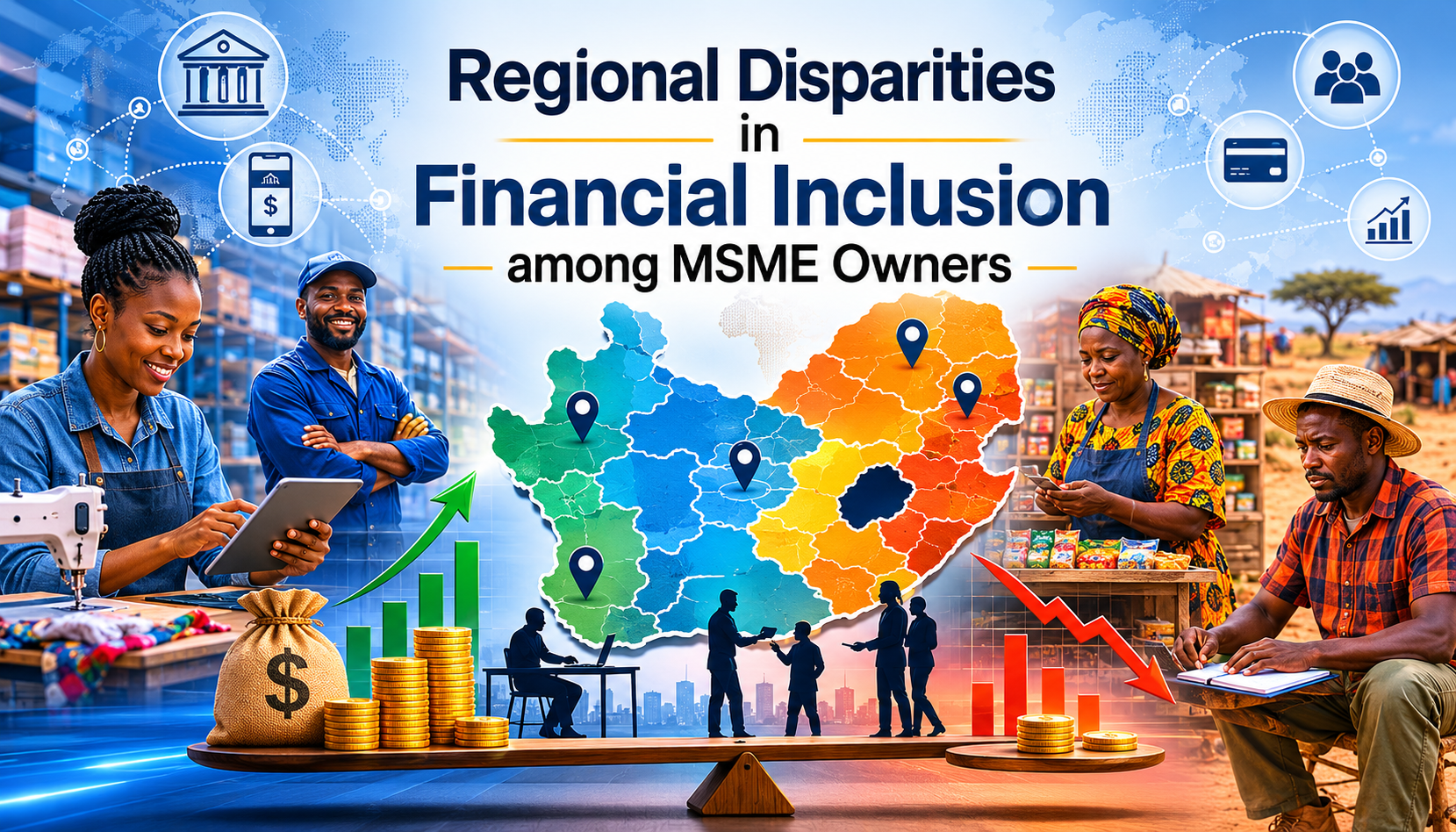
Micro, Small, and Medium Enterprises (MSMEs) are widely recognized as vital engines of economic growth, employment generation, and poverty alleviation, particularly in developing countries like Nigeria. In the North Central region of Nigeria, MSMEs contribute significantly to local economies and livelihoods, yet many of these enterprises remain financially excluded. However, the financial exclusion of MSMEs owners has been attributed to characteristics of MSMEs owners and unattractiveness of financial service. These discourage MSME owners from seeking financial services and engage with financial institutions. Additionally, there is dearth of comprehensive studies on this issue, particularly in North Central Nigeria, where the problem is reportedly endemic, highlighting the need for further study. Against this backdrop, it is essential to investigate the degree of difference of financial inclusion of MSMEs owners in the North Central, Nigeria. The specific objectives of the study were to; determine the degree of difference of financial inclusion of MSMEs owners in terms of (size of business, level of education, risk preference, financial literacy and social network, proximity to financial institutions, government financial support and financial service quality) in the North Central, Nigeria. The study employed survey research design method. The population of the study consists of 11,607 MSMEs owners in North central; Nigeria while both stratified and random sampling technique were employed. The sample size of 435 was determined via Krejcie & Morgan (1970) sample size formula. The data was analyzed using ANOVA. The findings of the study revealed that: (i) there is significant difference in the level of financial inclusion among MSME owners in the North Central, Nigeria. The study concludes that financial inclusion of MSMEs owners differs across the state in the North Central, Nigeria. Therefore, the study recommended that government and financial institutions should design region-specific programs that address the unique barriers faced by MSME owners in less financially included areas. This could include mobile banking initiatives, financial literacy training, and simplified loan application processes.
Abdulmumeen, O. K. (2017). Financial inclusion and poverty reduction in developing countries: A case study approach. International Journal of Financial Research, 8(2), 45–57. https://doi.org/10.5430/ijfr.v8n2p45
Africa Alliance for Financial Inclusion. (2017). Survey report on financial inclusion strategies in Africa. Alliance for Financial Inclusion. https://www.afi-global.org/publications/2017- financial-inclusion-survey/
Akudugu, M. A. (2023). Financial inclusion and inclusive growth in Sub-Saharan Africa: Recent evidence and policy implications. African Journal of Economic Policy, 30(1), 25–42.
Alliance for Financial Inclusion (AFI). (2017). 2017 AFI member survey report: Financial inclusion trends and priorities.
Alliance for Financial Inclusion. https://www.afi- global.org/publications/2017-afi-member-survey/
Alliance for Financial Inclusion (AFI). (2020). Global survey report on digital financial services and COVID-19. Alliance for Financial Inclusion. https://www.afi- global.org/publications/global-survey-report-dfs-covid19/
Babin, B. J., & Anderson, R. E. (2015). Consumer behavior: Building marketing strategy (13th ed.). Cengage Learning.
Camara, N., & Tuesta, D. (2018). Measuring financial inclusion: A multidimensional index. BBVA Research Working Paper No. 18/01. https://www.bbvaresearch.com/wp- content/uploads/2018/02/WP_18-01.pdf
Camara, N., Peña, X., & Tuesta, D. (2017). Factors that matter for financial inclusion: Evidence from Latin America. BBVA Research Working Paper No. 17/09. https://www.bbvaresearch.com/wpcontent/uploads/2017/07/WP_FinancialInclusion_1707.pdf
Collard, S. (2017). Financial literacy, financial education and financial capability: Lessons from UK experience. International Journal of Consumer Studies, 41(5), 502–509. https://doi.org/10.1111/ijcs.12310
Demirgüç-Kunt, A. (2016). The global findex database 2014: Measuring financial inclusion around the world. World Bank Publications. https://doi.org/10.1596/978-1-4648- 0772- 0.
Demirgüç-Kunt, A. (2018). The global findex database 2017: Measuring financial inclusion and the fintech revolution. World Bank Group. https://doi.org/10.1596/978-1-4648-1259-5
Demirgüç-Kunt, A. (2019). Financial inclusion: A key to achieving sustainable development goals. World Bank Blogs. https://blogs.worldbank.org/voices/financial-inclusion-key- achieving-sdgs
Demirgüç-Kunt, A., & Klapper, L. (2019). Measuring financial inclusion and the fintech revolution. World Bank Policy Research Working Paper No. 8696. https://doi.org/10.1596/1813-9450-8696
Fareeha, Z., & Abdul Jalil, A. (2019). Financial inclusion and economic growth: Evidence from South Asian economies. Asian Economic and Financial Review, 9(2), 221–236. https://doi.org/10.18488/journal.aefr.2019.92.221.236
G20 Seoul Summit. (2020). The Seoul summit document: Framework for strong, sustainable, and balanced growth. G20 Information Centre. https://www.g20.utoronto.ca/2020/seoul_summit_document.html
Grigorian, D. A., & Manole, V. (2016). Determinants of financial inclusion: Evidence from around the world. IMF Working Paper No. 16/127. International Monetary Fund. https://doi.org/10.5089/9781475504691.001
Paramasivan, C., & Ganeshkumar, V. (2017). Overview of financial inclusion in India. International Journal of Management and Development Studies, 6(1), 45–49.
Weise, P., & Samuel, M. (2018). The impact of financial technology on financial inclusion: Opportunities and challenges. Journal of Financial Innovation, 3(2), 58–74. https://doi.org/10.1007/s1234-018-00213
Hannig, A., & Jansen, S. (2018). Financial inclusion and financial stability: Current policy issues. Asian Development Bank Working Paper Series No. 259. https://www.adb.org/publications/financial-inclusion-and-stability-current-policy-issues
Jenkins, H., & Dillman, D. A. (2020). Mixed-mode surveys: Current practices and future directions. Public Opinion Quarterly, 84(S1), 180–203. https://doi.org/10.1093/poq/nfaa016
Jishajoseph, M., & Vargese, P. (2016). Role of financial literacy in promoting financial inclusion: A study in India. International Journal of Business and Management Invention, 5(4), 10–17.
Joshua, A. J. (2017). Impact of financial literacy on financial inclusion: A study among the urban poor in India. International Journal of Social Economics, 44(8), 1115–1132. https://doi.org/10.1108/IJSE-01-2016-0014
Kostov, P. (2019). Access to finance, financial inclusion and development: A cross-country analysis. Economic Modelling, 83, 55–65. https://doi.org/10.1016/j.econmod.2019.02.002
Krejcie, R. V., & Morgan, D. W. (1970). Determining sample size for research activities. Educational and Psychological Measurement, 30(3), 607–610. https://doi.org/10.1177/001316447003000308.
Krejcie, R. V., & Morgan, D. W. (1970). Determining sample size for research activities. Educational and Psychological Measurement, 30(3), 607–610. https://doi.org/10.1177/001316447003000308
Mantri, L. K. (2016). Financial inclusion: The key to economic growth and development in emerging economies. International Journal of Business and Economics Research, 5(2), 10–18. https://doi.org/10.11648/j.ijber.20160502.11
Naftaly, M., & John, K. (2021). Digital financial inclusion and economic empowerment: Evidence from East Africa. Journal of Financial Innovation, 4(3), 101–117. https://doi.org/10.1007/s1234-021-00215
Nielsen. (2016). The future of financial services: How disruptive innovations are reshaping the way financial services are structured, provisioned, and consumed. Nielsen Holdings PLC. https://www.nielsen.com/global/en/insights/article/2016/the-future-of-financial- services/
Novi, M., Bernhard, S., Joubert, P., & Maryam, S. (2018). The role of digital financial services in expanding financial inclusion. Journal of Financial Services Research, 53(2), 123– 140. https://doi.org/10.1007/s10693-017-0286-4
Novi, M., Bernhard, S., Joubert, P., & Maryam, S. (2018). The role of fintech in promoting financial inclusion: Evidence from developing economies. Journal of Financial Innovation, 4(1), 80–98. https://doi.org/10.1007/s1234-018-00215
OECD. (2017). OECD/INFE International Survey of Adult Financial Literacy Competencies. OECD Publishing. https://doi.org/10.1787/9789264282306-en.
Organisation for Economic Co-operation and Development (OECD). (2017). OECD/INFE international survey of adult financial literacy competencies. OECD Publishing. https://doi.org/10.1787/9789264281288-en
Paramasivan, C., & Ganeshkumar, V. (2017). Overview of financial inclusion in India. International Journal of Management and Development Studies, 6(1), 45–49.
Pineyro, J. (2016). Financial development and economic growth: Evidence from Latin American countries. Journal of Economic Policy Reform, 19(3), 265–281. https://doi.org/10.1080/17487870.2015.1105100
Rachel, L., Smith, A., & Turner, J. (2017). Household financial decision-making and financial literacy: A behavioral perspective. Journal of Economic Behavior & Organization, 133, 250–268. https://doi.org/10.1016/j.jebo.2016.11.012
Samuel, M. (2017). Financial inclusion in emerging economies: Challenges and opportunities. Journal of Emerging Market Finance, 16(3), 275–295. https://doi.org/10.1177/0972652717720787
Sapana, S., & Thakur, A. (2019). The impact of financial literacy on financial inclusion in developing countries: A study of Nepal. International Journal of Economics and Financial Issues, 9(1), 170–175.
Sarma, M. (2019). Measuring financial inclusion: Beyond the index. Economic Research-Ekonomska Istraživanja, 32(1), 71–90. https://doi.org/10.1080/1331677X.2018.1557117
Sarma, M., & Pais, J. (2019). Financial inclusion and development: A cross country analysis. Journal of International Development, 31(5), 701–725. https://doi.org/10.1002/jid.3430
Saurabh, S., Snehal, P., Radheshyam, B., & Pawan, J. (2023). Digital financial services and their impact on financial inclusion in India: An empirical analysis. Indian Journal of Economics and Business, 22(1), 15–34. https://doi.org/10.18311/ijeb/2023/30045
Sharma, A., & Kukreja, S. (2014). An analytical study: Relevance of financial inclusion for developing nations. International Journal of Business and Management, 9(6), 45–52. https://doi.org/10.5539/ijbm.v9n6p45.
Okafor, S. O., Ejelonua, H. O., & Onyekwere, C. G. (2022). Financial inclusion and micro, small and medium enterprises (MSMEs) development in Nigeria. International Journal of Innovation in Engineering, 2(2), 42–53. https://doi.org/10.59615/ijie.2.2.42
Shem, O., Ouma, S. A., Teresa, O., & Odongo, T. M. (2017). Mobile financial services and financial inclusion: Evidence from Kenya. African Development Review, 29(1), 52–65. https://doi.org/10.1111/1467-8268.12234
Weise, P. (2018). Digital finance and financial inclusion: How new technologies are changing the financial landscape. Journal of Financial Transformation, 47, 35–42.
Zins, A., & Weill, L. (2019). The determinants of financial inclusion in Africa. Review of Development Finance, 9(1), 20–28. https://doi.org/10.1016/j.rdf.2018.12.004
Copyright (c) 2026 Ahmed Adekunle, Abdullahi Adio Babatunde (Author)

This work is licensed under a Creative Commons Attribution-NonCommercial-NoDerivatives 4.0 International License.
By submitting your manuscript to IJABS, you agree and confirm that the paper you have submitted is your own original and unpublished work, does not contain any defamatory or other unlawful content(s), and you will accept responsibility for plagiarism. You and your co-authors retain copyright and grant BESRA the right of publication, with the work simultaneously licensed under a Creative Commons Attribution License 4.