Migration as Livelihood Strategy: A Mixed Methods Study of Household Welfare in Bagmati Province, Nepal

Downloads
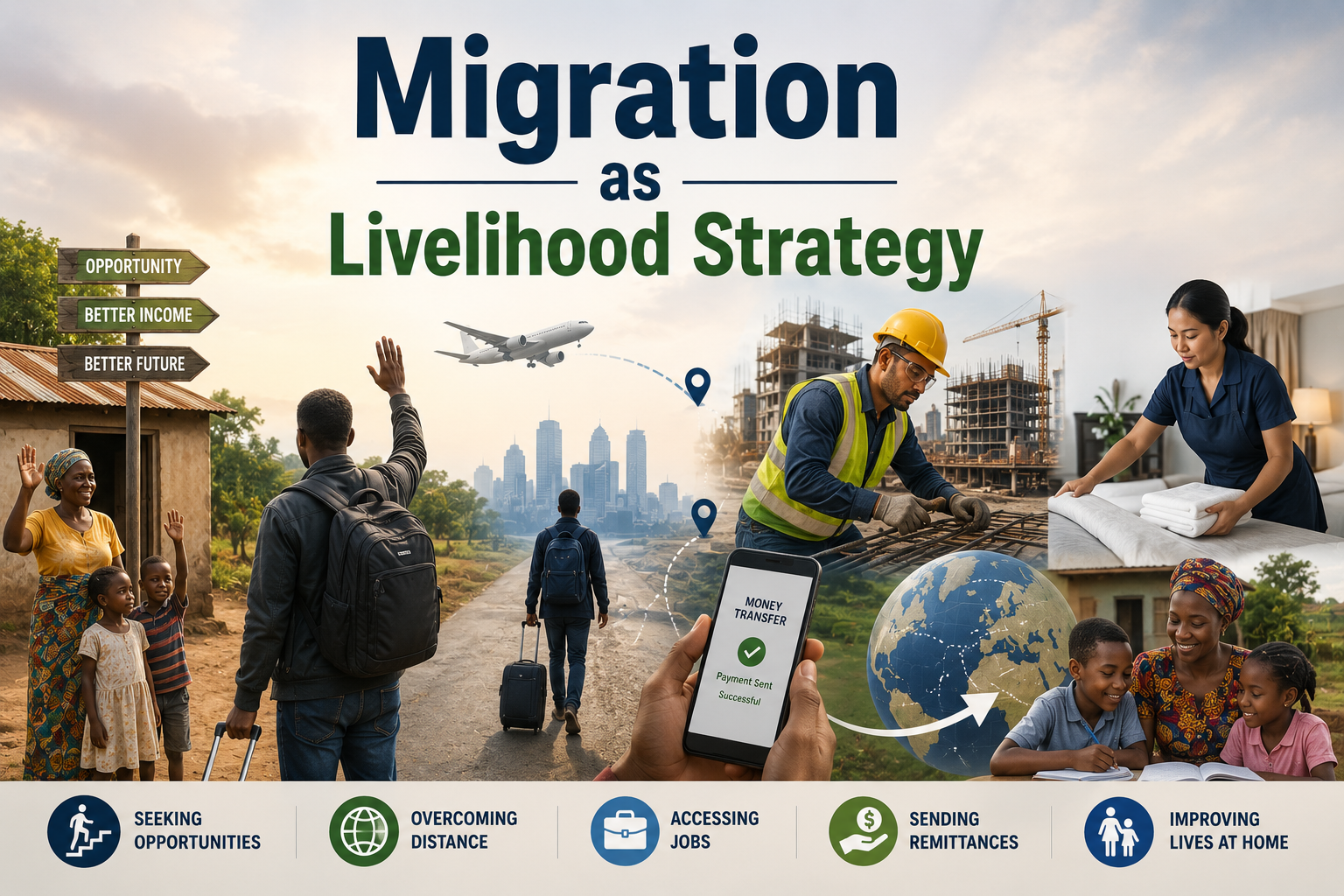
The study explores the role of migration in improving household livelihoods and reduce poverty focusing on Bagmati province of Nepal. The research employs a mixed methods approach combining quantitative surveys and qualitative interviews to analyze the impact of migration on household welfare, resilience, and economic outcomes. The study also focuses on household livelihoods, remittance allocation, and implications for livelihood diversification and rural sustainability. The key findings show that the livelihood level could be increased from migration and the lack of vocational skills training and availability of limited employment opportunities are the primary causes of the increasing trend of migration in Nepal. Policy recommendations focusing on sufficient vocational training opportunities to needy youths, awareness creation on migration regarding benefits, risks, and remittance utilization in productive investment to generate incomes at the community level.
Adhikari, J., Rai, M., Baral, C., & Subedi, M. (2023). Labour Migration from Nepal: Trends and Explanations. IMISCOE Research Series, 67–81. https://doi.org/10.1007/978-3-031-34194-6_5
Akiva, T., & Petrokubi, J. (2016). Growing with youth: A lifewide and lifelong perspective on youth-adult partnership in youth programs. Children and Youth Services Review, 69, 248–258. https://doi.org/10.1016/j.childyouth.2016.08.019
Billari, F. C. (2022). Demography: Fast and Slow. Population and Development Review, 48(1), 9–30. https://doi.org/10.1111/padr.12464
Carling, J., & Talleraas, C. (2016). Root causes and drivers of migration Implications for humanitarian efforts and development cooperation. PRIO Paper. https://www.prio.org/publications/9229
CBS. (2023). National Population and Housing Census 2021 National Report. In cbs.gov.np. National Statistics Office. https://censusnepal.cbs.gov.np/results/files/result-folder/National%20Report_English.pdf
De Haan, A. (1999). Livelihoods and poverty: The role of migration ‐ a critical review of the migration literature. Journal of Development Studies, 36(2), 1–47. https://doi.org/10.1080/00220389908422619
Ellis, F. (2003). A Livelihoods Approach to Migration and Poverty Reduction. Journal of Development Studies, 36. https://www.researchgate.net/publication/228593669_A_Livelihoods_Approach_to_Migration_and_Poverty_Reduction
Ellis, F. (2000). Rural Livelihoods and Diversity in Developing Countries. Oxford University Press, USA. https://www.researchgate.net/publication/42765249_Rural_Livelihood_Diversity_in_Developing_Countries_Evidence_and_Policy_Implications
FAO. (2016). CLIMATE CHANGE, AGRICULTURE AND FOOD SECURITY THE STATE OF FOOD AND AGRICULTURE. https://openknowledge.fao.org/server/api/core/bitstreams/07bc7c6e-72e5-488d-b2f7-3c1499d098fb/content
Fei, Z., & Tee, P. K. (2024). The relationship between Entrepreneurial Education and the Sustainable Development of SMEs in China: the mediating effect of Innovation Capability. International Journal of Advanced Business Studies, 3(2), 31–41. https://doi.org/10.59857/ijabs.7645
James-Wilson, D. (2008). YOUTH LIVELIHOODS DEVELOPMENT PROGRAM GUIDE. United States Agency for International Development. https://edc.org/wp-content/uploads/2024/10/EQUIP3-Livelihoods-Guide.pdf
Johnson, C. A. (1997). RULES, NORMS AND THE PURSUIT OF SUSTAINABLE LIVELIHOODS (IDS Working Paper 52). Institute of Development Studies. https://cdi.mecon.gob.ar/bases/doc/ids/wp52.pdf
Khatiwada, P. P. (2023). International Migration in Nepal: Rates, Drivers and Impacts. Journal of APF Command and Staff College, 6(01), 35–52. https://doi.org/10.3126/japfcsc.v6i01.57582
Kunwar, L. S. (2017). Emigration of Nepalese People and Its Impact. Economic Journal of Development Issues, 77–82. https://doi.org/10.3126/ejdi.v19i1-2.17705
Lenhardt, A. (2023). The role of migration in ending extreme poverty. Data and Evidence to End Extreme Poverty Research Programme. https://doi.org/10.55158/deeptp3
Lipton, M. (1980). Migration from rural areas of poor countries: The impact on rural productivity and income distribution. World Development, 8(1), 1–24. https://doi.org/10.1016/0305-750x(80)90047-9
Ministry of Finance. (2023). Economic Survey 2023/24. In mof.gov.np. Ministry of Finance. https://mof.gov.np/content/281/economic-survey-2023-24/
Ministry of Labour and Employment. (2016). Labour migration for employment A status report for Nepal: 2014/15. Government of Nepal. https://nepal.iom.int/sites/g/files/tmzbdl1116/files/documents/LabourMigrationReportEnglish-2014-15_0.pdf
Mukembo, S., & Edwards, C. (2020). Improving Livelihoods through Youth-Adult Partnerships involving School-based, Agripreneurship Projects: The Experiences of Adult Partners in Uganda. Journal of International Agricultural and Extension Education, 27(2), 62–76. https://doi.org/10.5191/jiaee.2020.27262
National Statistics Office (2025). International Migration in Nepal. Kathmandu: National Statistics Office. (National Population and Housing Census 2021). https://censusnepal.cbs.gov.np/results/files/result-folder/International%20Migration%20in%20Nepal%20Report.pdf
Nyberg-Sorensen, N., Hear, N. V., & Engberg-Pedersen, P. (2002). The Migration-Development Nexus: Evidence and Policy Options. International Migration, 40(5), 49–73. https://doi.org/10.1111/1468-2435.00211
Scoones, I. (1998). Sustainable Rural Livelihoods: A Framework for Analysis (Version 1). The Institute of Development Studies and Partner Organisations. https://hdl.handle.net/20.500.12413/3390
Shrestha, B. (2008). Contribution of Foreign Employment and Remittances to Nepalese Economy. NRB Economic Review, 1–15. https://doi.org/10.3126/nrber.v20i1.52808
Sijapati, B., & Limbu, A. (2017). Governing Labour Migration in Nepal (Updated). Himal Books for the Centre for the Study of Labour and Mobility. https://www.researchgate.net/publication/332354192_Governing_Labour_Migration_in_Nepal_An_Analysis_of_Existing_Policies_and_Institutional_Mechanisms (Original work published 2012)
Skeldon, R. (2002). Migration and poverty. Asia-Pacific Population Journal, 17(4), 67–82. https://doi.org/10.18356/7c0e3452-en
Taylor, E. J. (1999). The New Economics of Labour Migration and the Role of Remittances in the Migration Process. International Migration, 37(1), 63–88. https://doi.org/10.1111/1468-2435.00066
Tukundane, C., Minnaert, A., Zeelen, J., & Kanyandago, P. (2015). Building vocational skills for marginalised youth in Uganda: A SWOT analysis of four training programmes. International Journal of Educational Development, 40, 134–144. https://doi.org/10.1016/j.ijedudev.2014.10.007
United Nations. (2022). World Population Prospects 2022: Summary of Results. https://www.un.org/development/desa/pd/sites/www.un.org.development.desa.pd/files/wpp2022_summary_of_results.pdf
Wen, S., & Wee, V. E. K. (2025). Exploration of Problems and Solutions in Family Education. International Journal of Advanced Business Studies, 4(2), 1–6. https://doi.org/10.59857/wrkn5164
Copyright (c) 2026 Jeeb Narayan Kafle, Nasiruddin Molla (Author)

This work is licensed under a Creative Commons Attribution-NonCommercial-NoDerivatives 4.0 International License.
By submitting your manuscript to IJABS, you agree and confirm that the paper you have submitted is your own original and unpublished work, does not contain any defamatory or other unlawful content(s), and you will accept responsibility for plagiarism. You and your co-authors retain copyright and grant BESRA the right of publication, with the work simultaneously licensed under a Creative Commons Attribution License 4.