Understanding Occupational Stress and Managerial Supervisory Challenges in Botswana’s Private Tertiary Institutions: An Empirical Analysis

Downloads
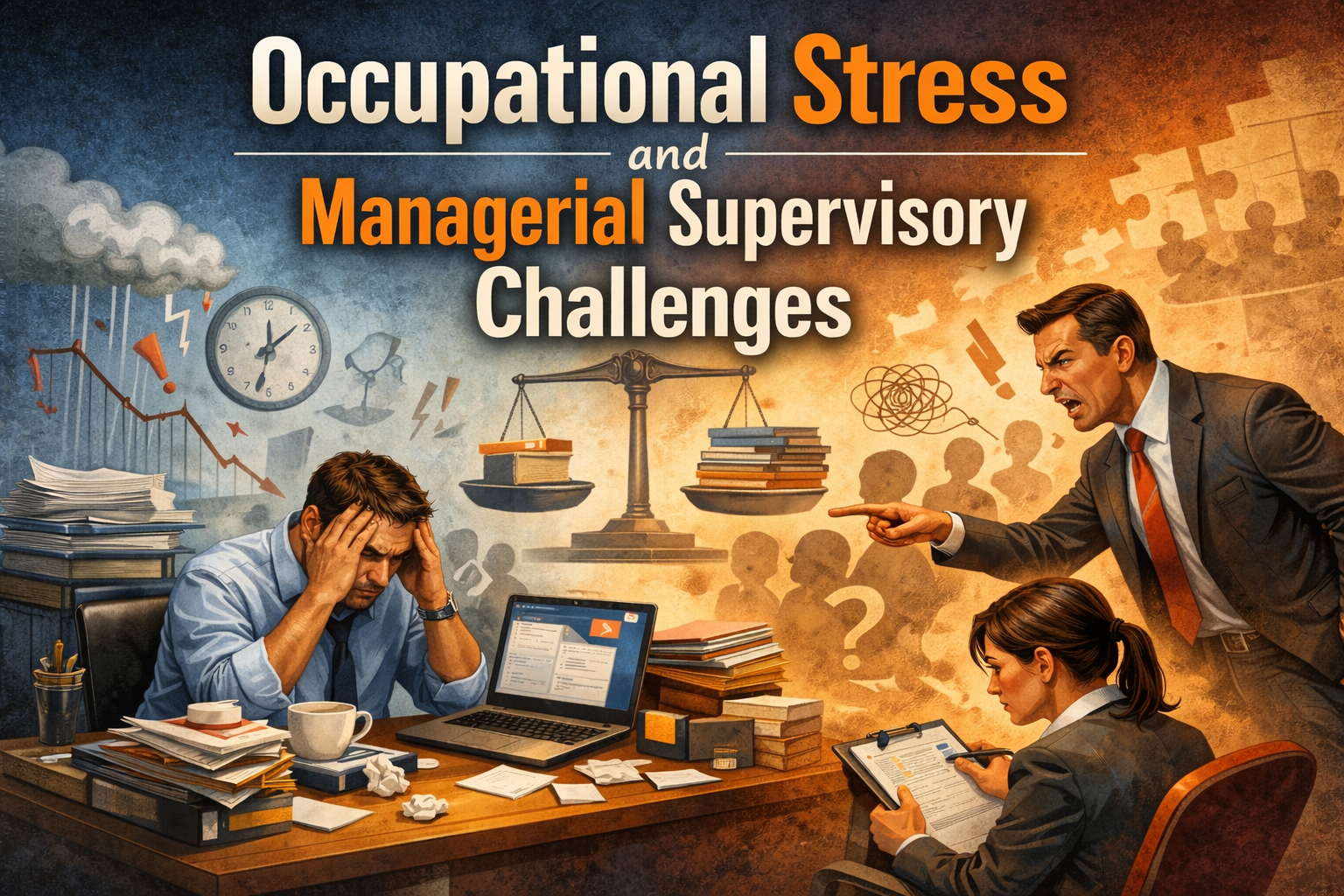
Occupational stress is a growing challenge in higher education, particularly in developing contexts where institutional resources and governance structures are often limited. This study investigates the key sources of occupational stress among academic staff in Botswana’s private tertiary institutions and examines the challenges faced by managers who supervise stressed lecturers. Using a mixed-methods approach that integrates survey data with qualitative insights from academic staff and managers in Gaborone, based on the findings of PhD thesis and shows that excessive workload, administrative demands, resource shortages, work life imbalance, and psychosocial pressures are the most prominent stressors affecting lecturers. Managers similarly report difficulty recognizing stress, balancing supervisory responsibilities, and navigating institutional constraints that limit supportive interventions. Reflecting international patterns, occupational stress in Botswana is closely tied to structural and organizational conditions rather than individual shortcomings. The study contributes context-specific evidence to the limited African literature on academic stress and highlights the need for strategic workload management, supportive leadership practices, and strengthened institutional systems within Botswana’s private tertiary sector.
Anees, R. T., Heidler, P., Cavaliere, L. P. L., & Nordin, N. A. (2021). Brain drain in higher education: The impact of job stress and workload on turnover intention and the mediating role of job satisfaction at universities. European Journal of Business and Management Research, 6(3), 1–8.
Aturu-Aghedo, C. (2024). Exploring occupational stress determinants and employee job performance in selected universities in North Central Nigeria. FUOYE Journal of Public Administration and Management, 2(1), 176–176.
Bakker, A. B., & Demerouti, E. (2007). The Job Demands–Resources model: State of the art. Journal of Managerial Psychology, 22(3), 309–328.
Caplan, R. D. (1987). Person–environment fit theory and organizations: Commensurate dimensions, time perspectives, and mechanisms. Journal of Vocational Behavior, 31(3), 248–267.
Ezenkiri, N. J., Mamman, H., Ezeani, U. D., & Torpev, T. F. (2021). Academic job: A review of stressors among teaching-staff of tertiary institutions. Sokoto Educational Review, 20(1&2), 1–11.
Faozen, F. (2019). Work stress: Antecedent variables and its impact on employee motivation and performance (Case study at the University of Muhammadiyah Jember). In Proceedings of ICOGISS 2019 (pp. 536–553).
Hargrove, M. B., Quick, J. C., Nelson, D. L., & Quick, J. D. (2011). The theory of preventive stress management: A 33-year review and evaluation. Stress and Health, 27(3), 182–193.
Hassan, Z., Ali, A., & Imran, M. (2024). Influence of workload and level of stress on work–life balance, organizational commitment and performance among the employees in higher education context of Maldives. Journal of Economics and Business Management, 3(12), 15–30.
Hilman, H., Edward, Y. R., & Faris, S. (2022). The effect of work–life balance and work stress on performance with job satisfaction as intervening variables at the Office of the Ministry of Religion, Selatan Tapanuli Regency. International Journal of Science, Technology & Management, 3(5), 1321–1348.
Mehmood, S., Husin, N. S., & Aziz, A. (2023). Do despotic leadership and workplace incivility predict turnover intention: A mediation by work-family conflict?. Journal of Intercultural Communication, 23(2), 120-135.
Hyatt, K. (2022). Stressors in higher education that lead to burnout and solutions to avoid it. Journal of Business and Educational Leadership, 12(1), 110-125.
International Labour Organization. (2016). Workplace stress: A collective challenge. ILO.
Indhu, R., & Thirumakkal, R. (2015). Workplace stress and coping strategies: A review. International Journal of Management, 6(1), 1–8.
Isa, Z., & Palpanadan, S. T. (2020). Lecturer workload and teaching performance: A conceptual analysis. Asian Journal of University Education.
Janib, J., Rasdi, R. M., Omar, Z., Alias, S. N., Zaremohzzabieh, Z., & Ahrari, S. (2021). The relationship between workload and performance of research university academics in Malaysia: The mediating effects of career commitment and job satisfaction. Asian Journal of University Education, 17(2), 85–99.
Jermsittiparsert, K., Petchchedchoo, P., Kumsuprom, S., & Panmanee, P. (2021). The impact of workload on job satisfaction: Does job stress matter? Academy of Strategic Management Journal, 20, 1–13.
Kahn, R. L., Wolfe, D. M., Quinn, R., Snoek, J., & Rosenthal, R. (1964). Organizational stress: Studies in role conflict and ambiguity. Wiley.
Kartini, T. M., Sellina, S., & Nugroho, A. P. (2023). The influence of workload, work stress and work–life balance on employee work performance. Jurnal Ekonomi, 12(04), 2547–2553.
Lawer, T. D. (2021). Job satisfaction, academic workload, perceived stress and coping strategies among lecturers of the University of Education, Winneba, Ghana (Doctoral dissertation, University of Cape Coast).
Luga, T. (n.d.). Work stress as predictor of job performance among academic staff of tertiary institutions in Nigeria. Kogi Journal of Sociology, 61.
Luzipho, N., Joubert, P. A., & Dhurup, M. (2023). Job stressors, work tension and job satisfaction of academics at a university in South Africa. SA Journal of Human Resource Management, 21, 2015.
Maslach, C., & Jackson, S. E. (1986). Maslach Burnout Inventory manual. Consulting Psychologists Press.
Mirkamali, S. M., Mazari, E., Khabare, K., & Zoughipour, S. (2016). Identify job stressors and their relationship with quality of work life (Case: faculty members of Birjand University). Organizational Culture Management, 13(4), 1133–1150.
Mohamedbhai, G. (2011). Higher education in Africa: Facing the challenges in the 21st century. International Higher Education, 63, 20–23.
Mulyadi, M., Sitiari, N. W., Meryawan, I. W., & Saputri, L. G. E. A. (2024). The role of workload, work–life balance and psychological factors on employee performance through work stress as mediation. Quality—Access to Success, 25(200).
Oyewole, B. K., & Agbesanya, F. O. (2024). Job stress as correlate of academic staff job performance in colleges of education in Southwest Nigeria. FUOYE Journal of Public Administration and Management, 2(1), 94–94.
Rashid, S., Subhan, Q. A., & Imran, M. (2022). Impact of work–life balance, workload and supervisory support on teachers’ job performance with mediating role of stress: A case of private institutions. International Journal of Business and Management Sciences, 3(1), 21–34.
Robbins, S. P. (2009). Organizational behavior (13th ed.). Pearson.
Selye, H. (1956). The stress of life. McGraw–Hill.
Tsalasah, E. F., Noermijati, N., & Ratnawati, K. (2019). The effect of work stress on employee performance, psychological well-being and subjective well-being (Study at PT. Global Insight Utama Bali area). MEC-J (Management and Economics Journal), 3(1), 95–107.
Teferra, D., & Altbach, P. G. (2003). African higher education: An international reference handbook. Indiana University Press.
Teferra, D., & Altbach, P. G. (2004). African higher education: Challenges for the 21st century. Higher Education, 47(1), 21–50.
Uwannah, N. C., Egwuonwu, C. O. K., & James, N. C. (2022). Job autonomy, workload and home–work conflict as predictors of job satisfaction among employed women in academia. European Journal of Educational Management, 5(1), 35–48.
Yousefi, M., & Abdullah, A. G. K. (2019). The impact of organizational stressors on job performance among academic staff. International Journal of Instruction, 12(3), 561–576.
Yousefi, M., Devi, R., & Shuib, A. (2020). Organizational stress indicators and influence on academic performance in private universities among academic personnel. Universal Journal of Educational Research, 8(3A), 1–5.
Zamri, M. N., Aziz, W. A. W. A., Rasak, N. T. S., & Suhaimi, M. H. (2024). The relationship between workload and job performance in private higher education institutions: A case study in Kolej Poly-Tech MARA, Northern Malaysia. e-Academia Journal, 13(2).
Copyright (c) 2026 Roselight Chuma Pepukai (Author)

This work is licensed under a Creative Commons Attribution-NonCommercial-NoDerivatives 4.0 International License.
By submitting your manuscript to IJABS, you agree and confirm that the paper you have submitted is your own original and unpublished work, does not contain any defamatory or other unlawful content(s), and you will accept responsibility for plagiarism. You and your co-authors retain copyright and grant BESRA the right of publication, with the work simultaneously licensed under a Creative Commons Attribution License 4.