The Impact of Sovereign Debt Crises and Sanctions on African Insurance and Reinsurance Markets: A Comparative and Policy-Oriented Analysis

Downloads
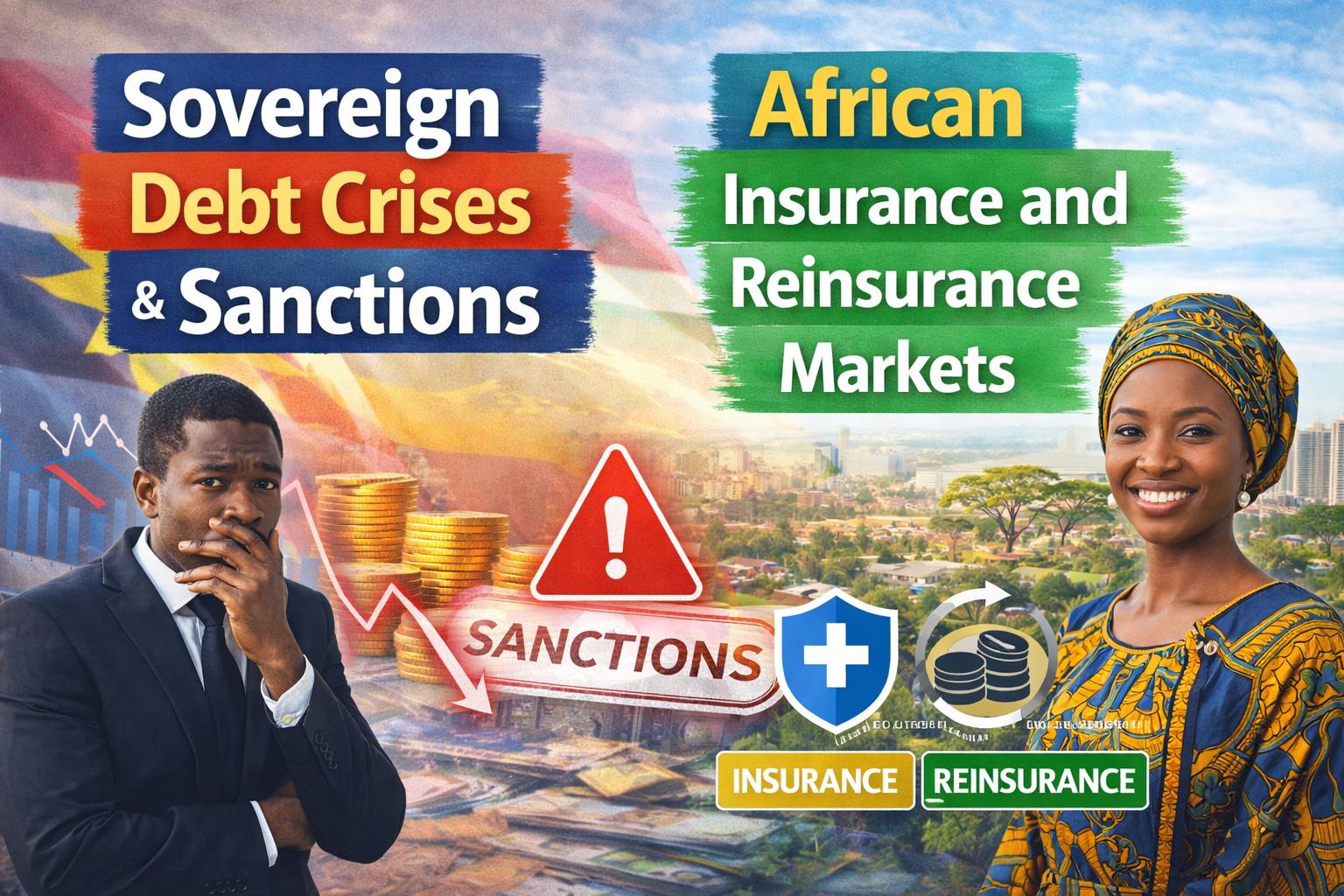
This study investigates the relationship between sovereign debt crises, international sanctions, and the stability of insurance and reinsurance markets in Africa. Utilizing a qualitative, desktop-based content analysis complemented by comparative case studies of Zimbabwe, Sudan, and Nigeria, the research delves into how macroeconomic instability, currency fluctuations, and regulatory fragmentation diminish underwriting capacity, weaken solvency margins, and erode market confidence. Grounded in Macro-Financial Fragility Theory, Regulatory Resilience Theory, and Institutional Political Economy, the analysis places Africa's situation within the broader context of systemic vulnerability. Comparative insights from Cuba, Argentina, Syria, and Russia further highlight how sovereign distress and sanctions alter market operations in settings with limited financial integration and restricted access to global risk-transfer mechanisms. The research reveals that sovereign debt distress undermines insurers' capital adequacy through inflationary erosion, valuation losses, and asset–liability mismatches, while sanctions intensify operational isolation, restrict reinsurance access, and increase compliance costs. Adaptive strategies—such as underwriting in foreign currencies, regional reinsurance pooling, and risk-based capital reforms—illustrate the importance of regulatory resilience in absorbing shocks. The paper contends that regulatory harmonization under the African Continental Free Trade Area (AfCFTA), bolstered by crisis-responsive reinsurance structures and enhanced institutional governance, is crucial for long-term sectoral stability. The findings offer a deeper understanding of the connections between macroeconomic fragility, regulatory capacity, and institutional quality in shaping the resilience of insurance markets across Africa.
Abeywickrama, J. P. L. N., & Cooray, T. (2025). Integrated Thinking and Firm Performance: Evidence from Sri Lankan Listed Companies. Journal of Contemporary Perspectives in Accounting and Digitalization, 8(1).
Acharya, V. V., & Steffen, S. (2016). Capital markets union in Europe: Why other unions must lead the way. Swiss Journal of Economics and Statistics, 152(4), 319-329.
AGBOOLA, A. B., OBALOLA, M. A., & ADULOJU, S. A. (2025). Underwriting Risk and Performance in the Non-Life Insurance Sector in Nigeria. Nigerian Journal of Risk and Insurance, 15(1), 43-57.
Aghion, P., Bacchetta, P., & Banerjee, A. (2001). Currency crises and monetary policy in an economy with credit constraints. European economic review, 45(7), 1121-1150.
Alizadeh, P., & Hakimian, H. (2013). Iran and the Global Economy. London and NewYork: Routledge Publishers.
Azfar, O., Kahkonen, S., Lanyi, A., Meagher, P., & Rutherford, D. (2018). Decentralization, governance and public services: The impact of institutional arrangements. In Devolution and development (pp. 45-88). Routledge.
Baluch, F., Mutenga, S., & Parsons, C. (2011). Insurance, systemic risk and the financial crisis. The Geneva Papers on Risk and Insurance-Issues and Practice, 36(1), 126-163.
Bernanke, B. S., Gertler, M., & Gilchrist, S. (1999). The financial accelerator in a quantitative business cycle framework. Handbook of macroeconomics, 1, 1341-1393.
BNM, B. N. M. (2022). An Exploration of Nature-Related Financial Risks in Malaysia.
Breen, M. (2024). THE IMF, FINANCIAL REGULATION, AND CAPITAL. Oxford Handbook of the International Monetary Fund, 260.
Calomiris, C. W., Jaremski, M., & Wheelock, D. C. (2022). Interbank connections, contagion and bank distress in the Great Depression✰. Journal of Financial Intermediation, 51, 100899.
Citaristi, I. (2022). African Development Bank—AfDB. In The Europa Directory of International Organizations 2022 (pp. 417-423). Routledge.
Claessens, S., & Kose, M. A. (2018). Frontiers of macrofinancial linkages. BIS Paper, (95).
Clift, B. (2025). Global economic governance and environmental crisis: the widening repertoire of IMF economic ideas and limits of its climate policy advocacy. Climate Policy, 25(8), 1266-1280.
Cooper, B., Rusare, M., Ferreira, M., & van Vuuren, L. J. (2020). Identity proofing for COVID-19 recovery: Guidance for regulators, FSPs and market facilitators.
Evans, J. W., & Davies, R. (Eds.). (2014). Too global to fail: The World Bank at the intersection of national and global public policy in 2025. World Bank Publications.
Haiss, P., & Sümegi, K. (2008). The relationship between insurance and economic growth in Europe: a theoretical and empirical analysis. Empirica, 35(4), 405-431.
Haldane, A. G., & May, R. M. (2011). Systemic risk in banking ecosystems. Nature, 469(7330), 351-355.
Hall, P. A., & Taylor, R. C. (1996). Political science and the three new institutionalisms. Political studies, 44(5), 936-957.
Harrington, B. (2016). Capital without borders: Wealth managers and the one percent. Harvard University Press.
Hielkema, S. A. Exploring the Role of Images in Organizational Communication about the Sustainable Development Goals on the Individuals’ Moral Legitimacy Judgments of Organizations.
Hodula, M. (2022). Does Fintech credit substitute for traditional credit? Evidence from 78 countries. Finance Research Letters, 46, 102469.
Kaminsky, G. L., & Reinhart, C. M. (1999). The twin crises: the causes of banking and balance-of-payments problems. American economic review, 89(3), 473-500.
Kern, A., Reinsberg, B., & Rau-Göhring, M. (2019). IMF conditionality and central bank independence. European Journal of Political Economy, 59, 212-229.
Klapper, R. G., Upham, P., & Blundel, R. K. (2021). Insider perspectives on growth: Implications for a nondichotomous understanding of ‘sustainable’and conventional entrepreneurship. Business Strategy and the Environment, 30(3), 1481-1496.
Laeven, L., & Valencia, F. (2020). Systemic banking crises database: A timely update in covid-19 times.
Lawuyi, R. (2023). Serving Two Masters: Corporate Governance Regulation in the Nigerian Insurance Industry. Available at SSRN 4442644.
Makina, D. (2017). Introduction to the financial services in Africa special issue. African Journal of Economic and Management Studies, 8(1), 2-7.
Marinov, E. (2025). Transforming Development: Circular Economy And Economic Growth In The Global South. Journal of Financial and Monetary Economics, 13(1), 236-248.
Mhlanga, D. (2020). Industry 4.0 in finance: The impact of artificial intelligence (AI) on digital financial inclusion. International Journal of Financial Studies, 8(3), 45.
Micheletti, E. (2024). Defining a Common Supervisory Framework for Internationally-Active Insurance Groups Solvency and Capital Adequacy: the IAIS Insurance Capital Standard.
Moussavi, S. (2024). Localized multilateralism: examining the african development bank. SAIS Review of International Affairs, 44(1), 37-49.
North, D. C. (1990). Institutions, institutional change and economic performance. Cambridge university press.
Okonkwo, I. V., & Eche, A. U. (2019). Insurance penetration rate and economic growth in Nigeria: 1981-2017. International Journal of Social Sciences and Management Review, 2(1), 21-45.
Owusu-Peprah, N. T. (2024). World Development Report 2022: Finance for an Equitable Recovery: by World Bank, Washington, DC, World Bank Publications, 2022, 267 pp., $0.00 (E-book), ISBN 9781464817311 (Vol. 38, No. 1, pp. 129-132). Routledge.
Parra, S. N., Zamora, J. V., Cecchi, L., Árnadóttir, R. E., Bonaglia, F., Edmunds, A., ... & Bendersky, M. (2024). Caribbean Development Dynamics 2025.
Post, A. S. E. A. N. (2017). ADB (Asian Development Bank). 2014. Key Indicators Report for Asia and the Pacific 2014. Manila: Asian Development Bank. ———. 2020. Key Indicators Report for Asia and the Pacific 2020. Manila: Asian Development Bank. Aditi, and M. Shariff. 2019.“Nipah Virus Infection: A Review”. Epidemiology and. Nature Communications.
Presbitero, A. F. (2012). Total public debt and growth in developing countries. The European Journal of Development Research, 24(4), 606-626.
Presbitero, A. F. (2012). Total public debt and growth in developing countries. The European Journal of Development Research, 24(4), 606-626.
Prince, A. E., & Schwarcz, D. (2019). Proxy discrimination in the age of artificial intelligence and big data. Iowa L. Rev., 105, 1257.
Reinhart, C. M., & Rogoff, K. S. (2011). From financial crash to debt crisis. American economic review, 101(5), 1676-1706.
Reinhart, C. M., Rogoff, K. S., & Savastano, M. (2003). Debt intolerance.
Robinson, J. A., & Acemoglu, D. (2012). Why nations fail: The origins of power, prosperity and poverty (pp. 45-47). London: Profile.
Stromquist, N. P. (2019). World Development Report 2019: The changing nature of work: By the World Bank. Washington, DC, World Bank, 2019, 151 pp. ISBN 978-1-4648-1342-9 (hbk). ISBN 978-1-4648-1328-3 (pbk), ISBN 978-1-4648-1356-6 (eBook), DOI: 10.1596/978-1-4648-1328-3.
Trein, P., Meyer, I., & Maggetti, M. (2019). The integration and coordination of public policies: A systematic comparative review. Journal of Comparative Policy Analysis: Research and Practice, 21(4), 332-349.
Wehrhahn, R. (2014). European Insurance and Occupational Pensions Authority. From Fragmentation to Financial Integration in Europe, 36, 353.
Copyright (c) 2026 Agripah Marangwanda (Author)

This work is licensed under a Creative Commons Attribution-NonCommercial-NoDerivatives 4.0 International License.
By submitting your manuscript to IJABS, you agree and confirm that the paper you have submitted is your own original and unpublished work, does not contain any defamatory or other unlawful content(s), and you will accept responsibility for plagiarism. You and your co-authors retain copyright and grant BESRA the right of publication, with the work simultaneously licensed under a Creative Commons Attribution License 4.